I've Been Approaching It the Wrong Way
After my experience described in the first part of this Guide, I finally had to admit something rather uncomfortable:
I had been going about choosing paintings the wrong way.
Not because I didn't like art.
Not because I didn't care about my home.
And certainly not because I lacked opinions.
The problem was much simpler.
I didn't know how to formulate the problem in the first place.
I had no clear criteria for evaluating a painting and no particular method for deciding whether a painting was actually right for me and my home.
Sometimes I treated paintings almost like colour spots.
This one would look nice against that wall.
That one would go nicely with the sofa.
And there is nothing terribly wrong with thinking about colour.
But surely a painting deserves a little more than the job of matching the curtains.
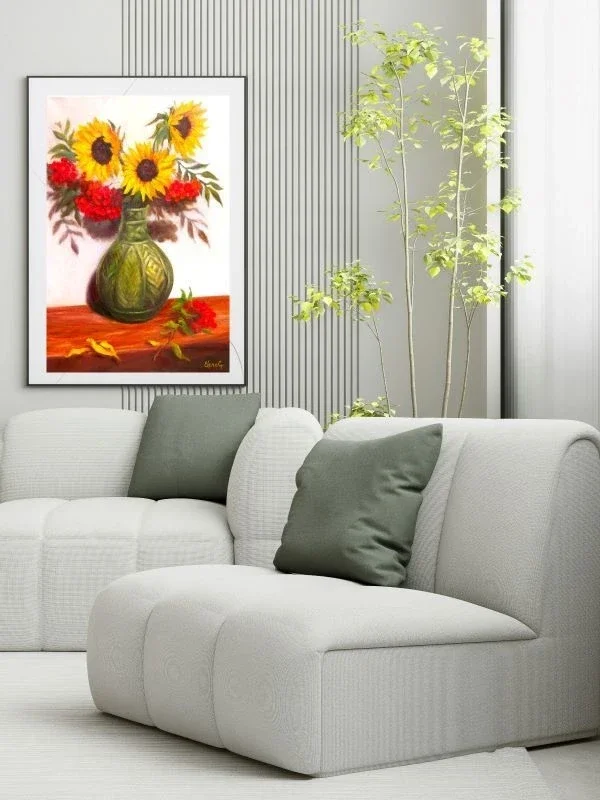
Here is a sample of when a so-bright painting does not fit that peaceful-coloured interior.
I could also have relied on friends whose taste I trusted.
Unfortunately, their homes looked like their homes—not mine.
So that wasn't much help either.
Then I did what most of us do when confronted with a question we cannot answer:
I went online.
That produced another problem.
There was far too much information.
There were articles about styles, periods, techniques, colour theory, composition, collecting, interior design, trends, artists, galleries...
After reading all this, I knew considerably more—and understood considerably less.
I became discouraged and put the whole subject aside.
For a while.
But the question kept returning.
Every time I looked at a wall that seemed to be waiting for something, my dissatisfaction returned with it.
Of course, there is always another option.
You can hire an interior designer and follow their advice.
That can be an excellent solution.
But there was something I wanted even more:
I wanted to be able to choose a painting myself.
I wanted to look at a canvas, make my own decision, take it home, and later discover I had made the right one.
After all, isn't that part of the pleasure?
We learn by doing.
And, as we all eventually discover, experience is a rather expensive teacher—but fortunately, she is persistent.
Then I had an unexpected lesson.
One day, at an art exhibition in our city's art centre, I happened to overhear a conversation.
A grey-haired gentleman was helping his companion understand a painting that had caught my attention as well.
I don't know who he was.
I don't know whether he was a professional collector, an art historian, or simply a well-experienced art lover.
But he spoke with such calm confidence that I immediately became a student.
His first question was surprisingly simple:
Does the painting attract you emotionally?
Not:
Is it fashionable?
Not:
Is the artist famous?
Not:
Will somebody else approve of my choice?
Just:
Does it speak to you?
If the answer was yes, he suggested looking more carefully.
Then came the second step:
Look at the composition.
How are the elements arranged?
Does your eye move comfortably through the painting?
Is there balance?
Is the distribution of light and important forms working for you?
I remember thinking:
Composition. Right. I should probably understand something about composition.
Then came colour.
How do the colours work together?
How does the light interact with the darker areas?
Does the colour harmony create the feeling that the painting seems to promise?
Then details.
Technique.
The way the artist has handled the surface and the individual elements.
And finally, after all that looking, he suggested something particularly important:
Step back and look at the painting as a whole again.
And then ask yourself:
Could I live with this painting?
Not for five minutes.
Not for the length of an exhibition visit.
But every day.
In my home.
That last question stayed with me.

Here we see a well-balanced landscape painting by ElenaG. A horizontal line of earth is classically divided into one-third (water) and two-thirds (sky).
So I tested the theory.
I moved to another painting. Then another. And I tried to follow the little system I had just learned. First impression.
Emotion. Composition. Colour and light. Details and technique. Then the whole painting again.
And something rather surprising happened. It was as if I had entered a different dimension.
I wasn't simply looking at paintings anymore.
I was looking into them.
A painting began to reveal things I hadn't noticed before.
Occasionally I liked it more.
Occasionally I liked it less.
And occasionally I realized that although a painting was very good, it simply wasn't for me.
That was an important discovery.
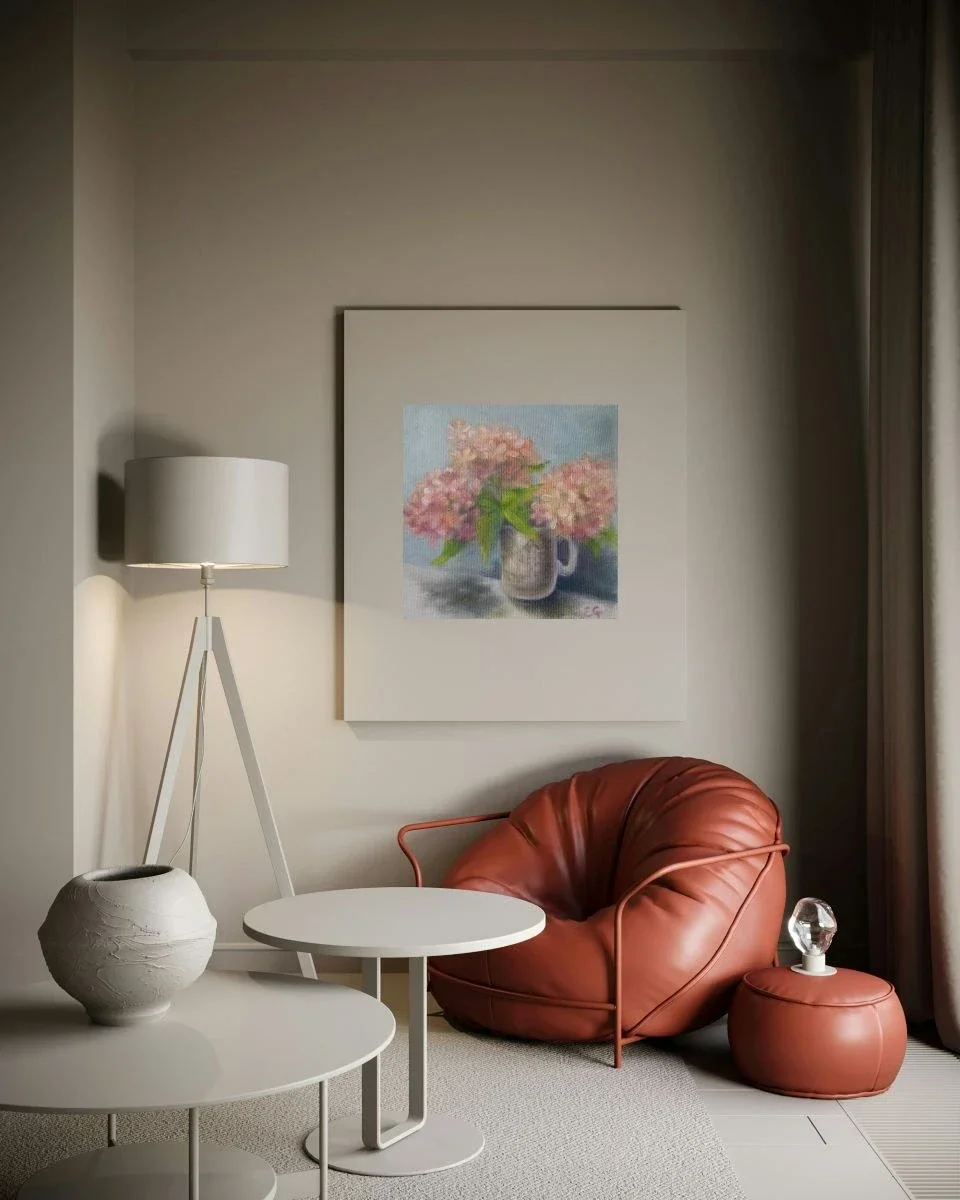
Here we see a balanced choice of painting by ElenaG in a certain interior.
I had always thought that appreciating art meant deciding whether a painting was good or bad.
Perhaps the better question is occasionally:
Is this painting right for me?
And then something even more interesting happened.
I began to feel as though I were having a conversation with the artist.
The artist had put something on the canvas.
I brought my own experience to it.
And somewhere between the two, a connection either appeared—or it didn't.
But there is more to it.
Recently I came across another idea that I found equally convincing: Forget the rules and trends.
The most meaningful art can be deeply personal. Perhaps it is a particular colour that makes you stop and think.
A quiet landscape that reminds you of somewhere. Flowers that create a feeling of calm.
A certain arrangement of forms that makes you curious. Or simply a painting that makes you want to sit down and look at it for another minute. And that is where I think the two approaches meet.
The head asks: Why does this painting work?
The heart asks: Why does this painting speak to me?
Perhaps we need both.
The head helps us understand what we are looking at.
The heart helps us understand why we want to live with it.
And once I understood that, choosing paintings became a very different experience.
But I still had one important question.
How do we take all of this knowledge and use it when choosing a painting for a particular home, a particular room, and a particular person?
That was the point where my little experiment became something much more systematic.
And that is where we go next. To Be Continued (Please tap the red button below)