The Night Dalí Shocked Paris Art Critics.

In 1930s Paris, the art world thrived on bold ideas—and even bolder criticism.
Salvador Dalí and Picasso: A Surprising Artistic Defence.
In 1930s Paris, the art world thrived on bold ideas—and even bolder criticism. At the centre of one unforgettable moment stood Salvador Dalí, a rising star of Surrealism, known as much for his eccentric personality as for his paintings.
Across the artistic landscape loomed Pablo Picasso, already famous but increasingly controversial.
Critics questioned Picasso’s influence, his methods, and even his legacy.
What they didn’t expect was that Dalí—young, unpredictable, and unapologetically strange—would become one of Picasso’s most dramatic defenders.
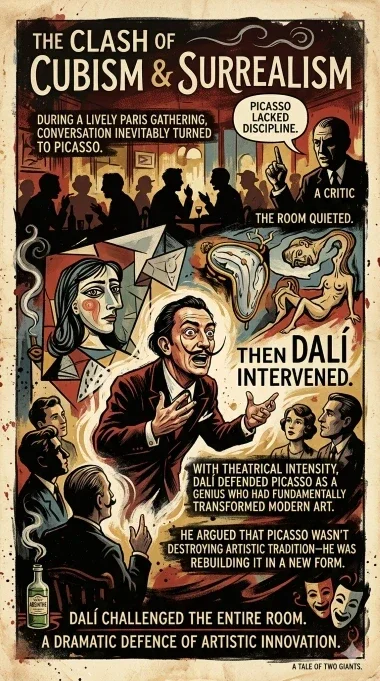
Two Sides of a Genius: Exploring the rigid structures of Picasso’s Cubism against the fluid, dreamlike hallucinations of Dalí’s Surrealism.
Why Critics Turned Against Picasso.
By the early 20th century, Picasso had already revolutionized art through Cubism.
But innovation comes at a cost.
Many critics argued that Cubism had gone too far.
They claimed Picasso had abandoned traditional beauty and replaced it with fragmentation and confusion.
In Parisian salons and cafés, dismissing Picasso had become fashionable.
For some, it was an intellectual critique.
Others just found it simpler than attempting to comprehend his work.
The Night Dalí Shocked Paris Critics.
During a lively Paris gathering filled with artists, writers, and critics, the conversation inevitably turned to Picasso.
A critic confidently declared that Picasso lacked discipline.
The room quieted.
Then Dalí intervened.
With theatrical intensity, Dalí defended Picasso as a genius who had fundamentally transformed modern art. He argued that Picasso wasn’t destroying artistic tradition—he was rebuilding it in a new form.
Dalí didn’t just disagree.
He challenged the entire room.
Those who criticized Picasso, he suggested, were not seeing the full picture.
At that moment, Dalí turned a casual discussion into a dramatic defence of artistic innovation.
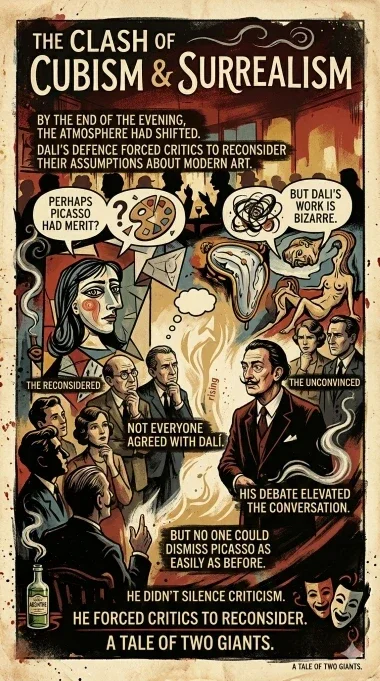
Time and Form: Where Picasso deconstructed the physical world, Dalí deconstructed the subconscious. Our latest deep dive explores how these two masters redefined 20th-century reality.
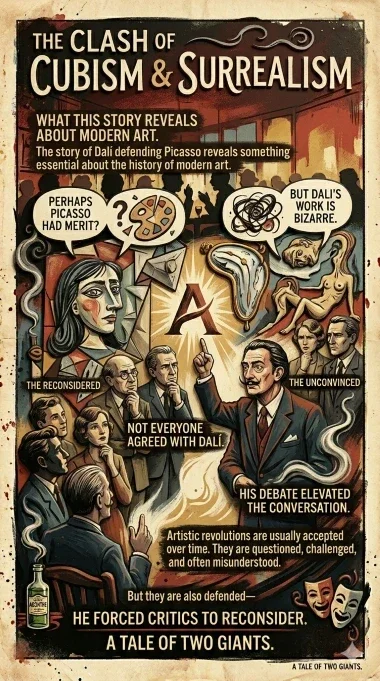
Icons of Spain: One sought the primitive power of the bull; the other, the fragile elevation of the elephant—a look at the shared roots and diverging paths of Spain's greatest artists.
Dalí, Picasso, and Modern Art Innovation.
Dalí’s admiration for Picasso was rooted in more than personality—it was grounded in artistic evolution.
Picasso reshaped reality through structure and abstraction.
Dalí explored reality through dreams and the subconscious, becoming a defining figure of Surrealism.
To illustrate their connection and contrast, consider these iconic works:
- Picasso – “Les Demoiselles d’Avignon” (1907)
https://www.moma.org/collection/works/79766 - Dalí – “The Persistence of Memory” (1931)
https://www.moma.org/collection/works/79018
These paintings highlight two different approaches to modern art.
Picasso deconstructs form.
Dalí transforms perception.
Together, they represent a powerful shift in how artists approached reality.
Respect Without Imitation: Dalí’s Unique Perspective.
Despite his admiration, Dalí never attempted to imitate Picasso.
He was fiercely committed to originality.
Dalí respected Picasso not as a model to copy, but as a pioneer who had expanded what art could be.
This distinction is important.
Dalí’s defence of Picasso wasn’t about loyalty—it was about recognizing artistic genius.
In doing so, he demonstrated a rare quality among artists: the ability to celebrate greatness without losing one’s own identity.
How Dalí Changed the Conversation About Picasso.
By the end of the evening, the atmosphere had shifted.
Not everyone agreed with Dalí.
But no one could dismiss Picasso as easily as before.
Dalí’s passionate defence forced critics to reconsider their assumptions about modern art.
He didn’t silence criticism.
He elevated the conversation.
And in doing so, he reinforced Picasso’s position at the centre of artistic innovation.
What This Story Reveals About Modern Art.
The story of Dalí defending Picasso reveals something essential about the history of modern art.
Artistic revolutions are usually accepted over time.
They are questioned, challenged, and often misunderstood.
But they are also defended—sometimes by unexpected voices.
Dalí recognized that Picasso’s work represented a turning point in art history.
By defending him, Dalí wasn’t just supporting another artist.
He was defending the future of art itself.
Conclusion: When Artists Defend Artists.
The night Salvador Dalí defended Pablo Picasso was more than an anecdote.
It’s a reminder that behind major artistic movements are moments of courage—moments when one artist stands up for another.
Dalí may have been known for his surreal ideas and eccentric behaviour.
But in this case, his message was clear.
Great artists recognize each other—even when the world does not.
And sometimes, it takes a bold voice to make others see what has been there all along.
For those who want to return to the contemporary art of nowadays, I suggest following those links: https://www.artbyelenag.com/blogs-heart-to-heart-talks/2031084_blog-6-new-edition
https://www.artbyelenag.com/figurative-gallery or
Nik, art history lover.
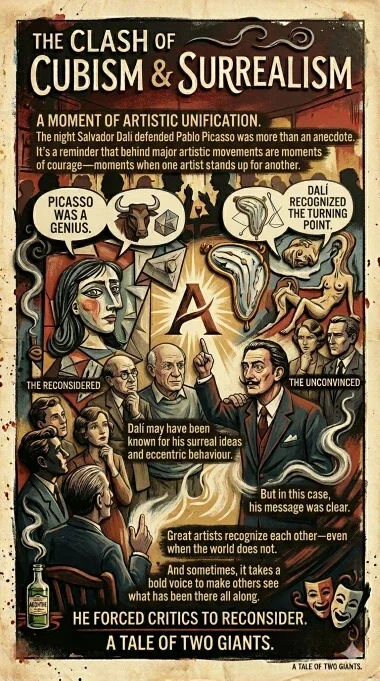
A Rivalry in Paint: They admired each other, envied each other, and changed the course of art history together. Read about the complex relationship between the two titans of the avant-garde.
I conceived the blog article concept and edited it, and I utilized ChatGPT to compose the text. Some images were created with Gemini.
P.S. You can follow those links to be more impressed by famous artworks by two great artists of the 20th century:
https://www.wikiart.org/en/salvador-dali/the-great-masturbator-1929
https://www.wikiart.org/en/pablo-picasso/girl-on-the-ball-1905
Add comment
Comments