The Day Degas Played Detective: How One Impressionist Defended Mary Cassatt.

Paris in the late 1870s was noisy, competitive, and full of artistic ambition, and every young artist aspired to gain acceptance from the powerful Paris Salon.
A Small Mystery in Paris.
Paris in the late 1870s was noisy, competitive, and full of artistic ambition. Arguments about painting buzzed in cafés, critics sharpened their pens, and every young artist aspired to gain acceptance from the powerful Paris Salon.
Among them was Mary Cassatt, an American artist who had come to Paris with determination and a rather radical idea: that a woman could build a serious professional career in art.
Unfortunately, the art establishment did not share her enthusiasm.
The Salon rejected several of her works, critics remained skeptical, and the unwritten rules of the time suggested that women should paint delicate domestic scenes rather than compete with male painters.
Cassatt’s situation looked like a classic Parisian mystery.
But every intriguing mystery eventually introduces a detective.
And in this story, the detective was Edgar Degas.
The Unexpected Invitation.
Degas was already known in artistic circles for his sharp opinions, fierce independence, and an eye for talent that rarely failed him.
When he saw Cassatt’s paintings in a gallery window in 1877, he immediately recognized something special.
Later, he reportedly told her:
"I admired your work. I felt you were one of us."
The “us” he referred to was the rebellious group of painters known as Impressionism.
These artists had grown tired of waiting for approval from the Salon. Instead, they organized their own independent exhibitions.
Degas invited Cassatt to join them.
It was more than a friendly gesture—it was a professional endorsement.
Suddenly, the American outsider had powerful allies in the Paris art world.
Evidence on Canvas.
Degas didn’t just defend Cassatt with words. He also defended her with art.
One of the most fascinating examples is his print, “Mary Cassatt at the Louvre: The Painting Gallery.”
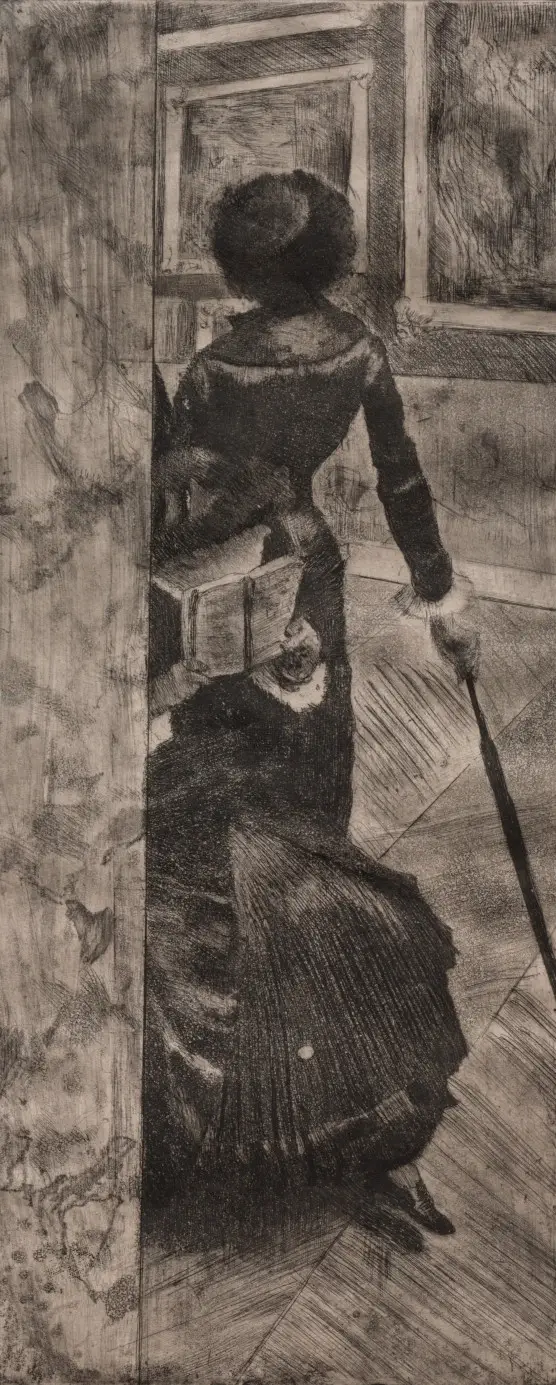
Edgar Degas depicts Mary Cassatt in a modern, candid, and candidly observed setting, a hallmark of Impressionist studies of everyday life, showcasing her in a "confident pose" at the museum.
Artwork Details:
Artist: Edgar Degas.
Year: 1879-80.
Art Movement: Impressionism.
Medium: etching, softground etching, and aquatint
Culture: France, 19th century
In the artwork, Cassatt stands in a gallery studying paintings with intense concentration, while her sister Lydia sits nearby.
The scene quietly sends a message.
Cassatt is not portrayed as a casual visitor but as a serious artist analyzing masterpieces. Degas presents her as a professional observer—someone who belongs in the world of art.
Without writing a single sentence, he offered a visual argument in her defence.
In detective terms, her presence was powerful evidence.
The Impressionist "Conspiracy."
Once Cassatt joined the Impressionists, something remarkable happened.
Instead of competing with each other, many of the artists collaborated and experimented together.
Degas and Cassatt in particular shared an interest in printmaking. They worked with techniques such as etching and aquatint, exchanging ideas and pushing each other to explore new possibilities.
At one point, they even planned an ambitious print publication called Le Jour et la nuit (“Day and Night”), which would showcase innovative graphic works.
Artwork details:
Artist: Edgar Degas (French, Paris 1834-1917).
Year: 1879-1880.
Medium: Mix intaglio.
Art Movement: Impressionist.
Culture: France, 19th century.
Location: Toledo Museum of Art https://toledomuseum.org/
More at https://emuseum.toledomuseum.org/objects/45767/mary-cassatt-at-the-louvre--the-etruscan-gallery
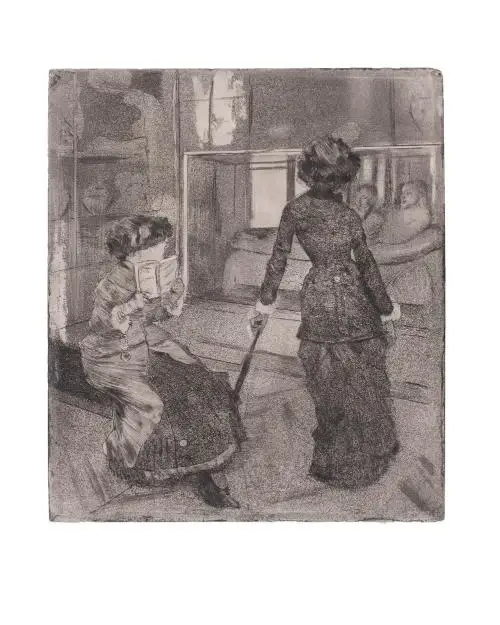
This print is one of two in which Edgar Degas depicted Mary Cassatt and her sister Lydia at the Musée du Louvre. In this iteration of the subject, Casatt gazes intently at an Etruscan tomb, about 500 BC, excavated at Cerveteri, the largest ancient necropolis in the Mediterranean.
Imagine a group of artists in Paris studios, planning how to outsmart traditional critics.
Their tools were simple: copper plates, ink, and imagination.
Degas admired Cassatt’s discipline and intelligence. Cassatt admired Degas’s technical mastery.
Their conversations were sometimes intense—Degas was famous for arguing with everyone—but the mutual respect between them remained strong.
Cassatt’s Breakthrough.
Around this time, Cassatt created one of her most famous paintings.

The work by Mary Cassatt, an American painter based in Paris, was invited by Degas to exhibit with the Impressionists. It emphasizes light and a "snapshot" quality, departing from traditional, formal portraiture by showing a young girl in a casual, somewhat "unladylike" pose (sprawled in an armchair).
Artwork Details:
ARTIST: Mary Cassatt
YEAR: 1878
MEDIUM: Oil on canvas
ART MOVEMENT: Impressionism
LOCATION: National Gallery of Art, Washington, D.C. https://en.wikipedia.org/wiki/National_Gallery_of_Art
The painting, “Little Girl in a Blue Armchair,” shows a child sprawled casually in a large chair, her relaxed posture capturing a surprisingly modern moment.
Art historians believe Degas may have suggested changes to the composition.
If that is true, it shows how deeply the two artists influenced each other’s work.
Instead of rivalry, their relationship was based on collaboration.
Degas's support served as expert testimony in Cassatt's favour at a time when female artists often faced neglect.
Gradually, critics began to take her seriously.
The Final Reveal.
Every good detective story ends with a revelation.
Here is ours.
Degas did not create Mary Cassatt’s talent. She already possessed the skill, determination, and artistic vision needed to succeed.
What he did was recognize her ability when others failed to see it.
Artwork Details
Artist: Mary Cassatt
Year: 1878
Movement: Impressionism
Medium: Oil on canvas
Location: Museum of Fine Arts, Boston
https://en.wikipedia.org/wiki/Museum_of_Fine_Arts,_Boston

Cassatt presents her female figure as an active, independent observer, reversing the gendered power dynamic of looking.
By inviting her into the Impressionist exhibitions and publicly supporting her work, he helped open doors that had previously been closed.
Cassatt would go on to become one of the most important figures of the Impressionist movement.
Not bad for an artist once rejected by the Salon.
Case Closed… Almost.
This story reminds us that the history of art is not only about rivalry and competition.
Sometimes it is also about friendship.
Behind many masterpieces lies a quiet tale of encouragement, loyalty, and well-timed defence.
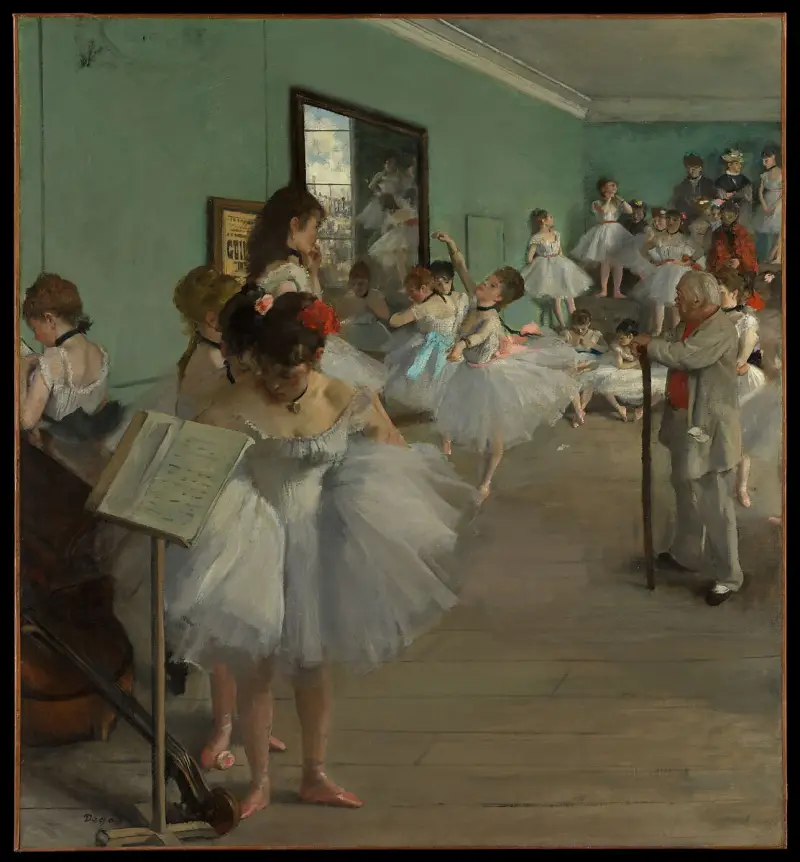
Edgar Degas depicts a crowded rehearsal room, focusing on a young dancer with a pink sash in the centre who is performing for the ballet master, Jules Perrot.
Artwork Details:
Artist: Edgar Degas. (French, Paris 1834-1917)
Year: 1874.
Art Movement: Impressionism.
Medium: Oil on canvas.
Culture: France, 19th century.
Location: The Metropolitan Museum of Art https://www.metmuseum.org/art/collection/search/438817
Degas may not have solved a crime.
But he did help solve a misunderstanding.
And in the dramatic world of nineteenth-century Parisian art, that was an achievement worthy of any detective.
Those who want to be back in nowadays
Right now, I suggest the following link:
https://www.artbyelenag.com/figurative-gallery
Nik, an art collector and art history lover.
The creator of this blog is also the driving force behind its concept. After writing the text, the author used AI to make modifications. (ChatGPT)
Add comment
Comments