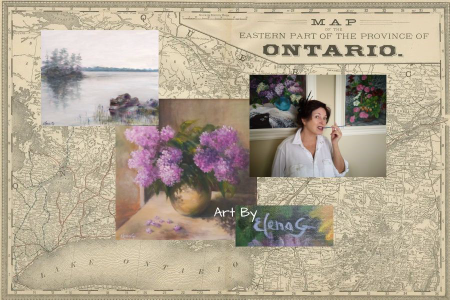
Why Paint a Landscape When Your Phone Already Has a Camera?
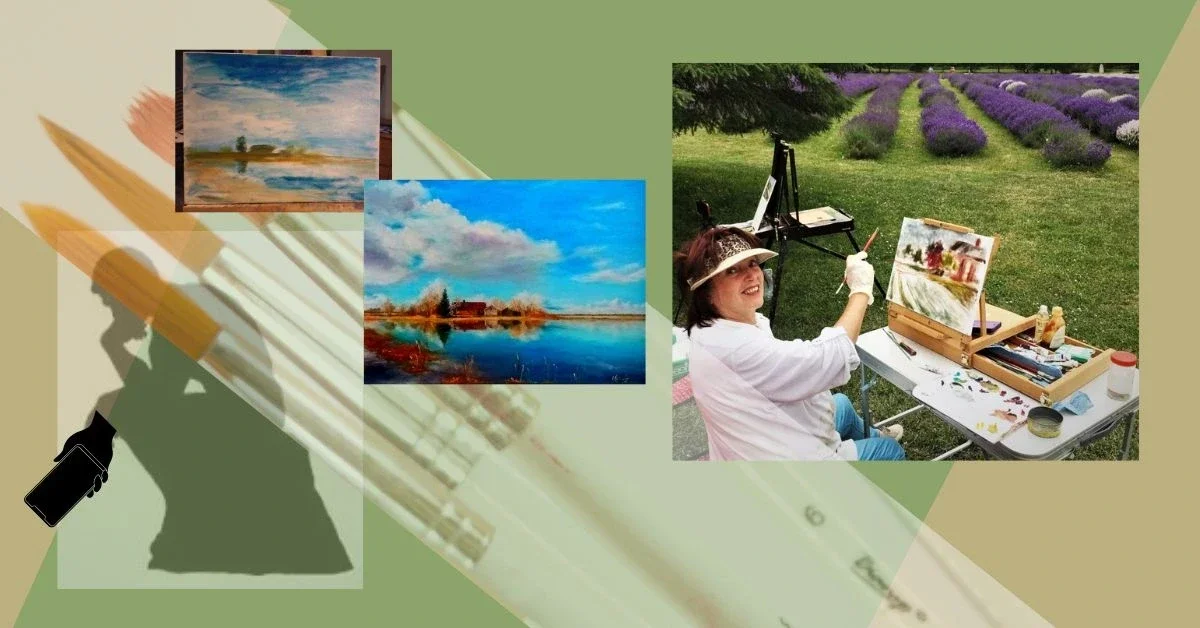
“Why do artists still paint landscapes when every smartphone can photograph a sunset better than any human hand?”
The Strange Persistence of the Painted Horizon.
People often ask me a very reasonable question:
“Why do artists still paint landscapes when every smartphone can photograph a sunset better than any human hand?”
And honestly? They are absolutely right.
Today, every traveller carries a tiny digital god in their pocket. In a single vacation, a person can collect hundreds of glowing sunsets, dramatic mountain ridges, restless oceans, sleepy valleys, suspiciously photogenic clouds, and enough edited colour filters to make even nature question its own original palette.
One swipe — and your lake becomes cinematic.
Another swipe — and Tuscany suddenly looks like a perfume commercial.
So yes, technology has already won the speed competition.
But painting was never about speed.
Painting is about obsession.
As soon as you start creating art, something deeply irrational takes over. Every canvas becomes an expedition into unknown territory. In this sense, the artist resembles Christopher Columbus—not because we discover America every Tuesday, but because every new painting feels like approaching a horizon no one has mapped before.
A camera captures what already exists.
A painting captures what happens to you while looking at it.
And that difference changes everything.
For many collectors of Contemporary Fine Art, this distinction is exactly why painting remains emotionally irreplaceable. A photograph documents it. A painting transforms.
The Bob Ross Trap We All Secretly Fall Into.
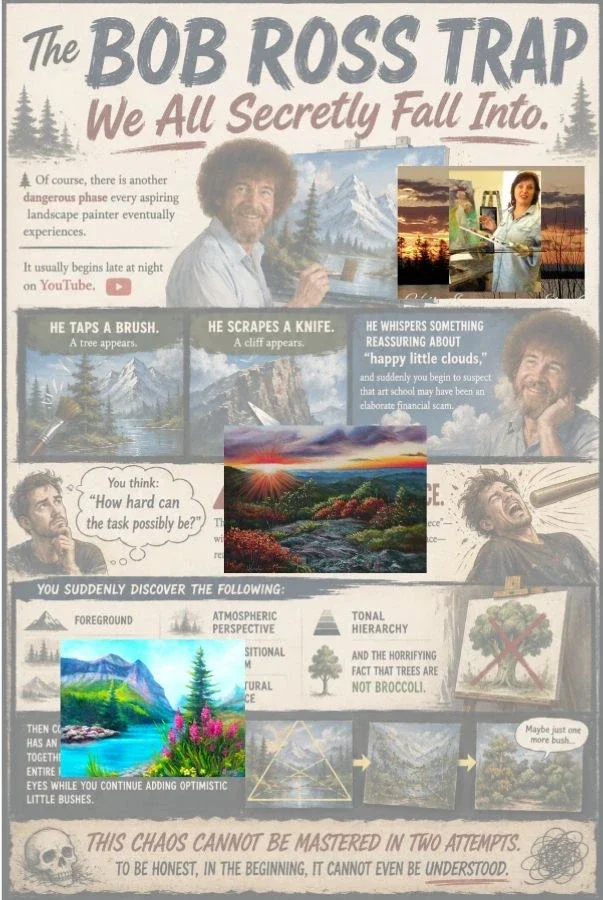
This chaos cannot be mastered in two attempts. To be honest, in the beginning, it cannot even be understood.
Of course, there is another dangerous phase every aspiring landscape painter eventually experiences.
It usually begins late at night on YouTube.
Suddenly, there appears Bob Ross, smiling with supernatural kindness while casually producing an entire mountain range in approximately four and a half minutes.
He taps a brush.
A tree appears.
He scrapes a knife.
A cliff appears.
He whispers something reassuring about “happy little clouds,” and suddenly you begin to suspect that art school may have been an elaborate financial scam.
You think:
“How hard can the task possibly be?”
A catastrophic sentence.
The moment you sit down to paint your own “masterpiece”—with quotation marks large enough to be seen from space—reality arrives, wielding a baseball bat.
You suddenly discover the following:
- foreground,
- middle ground,
- background,
- atmospheric perspective,
- compositional rhythm,
- structural balance,
- tonal hierarchy,
- and the horrifying fact that trees are not broccoli.
Then comes the realization that composition has an invisible skeleton holding everything together. If that structure collapses, the entire painting dies quietly in front of your eyes while you continue adding optimistic little bushes.
This chaos cannot be mastered in two attempts.
To be honest, in the beginning, we cannot even understand it.
The Unromantic Truth About Becoming a Modern Artist.
I passed through all those stages myself.
At first, I wanted quick results. Fast sketches. Immediate beauty. Preferably before lunch.
But gradually, enthusiasm gave way to technical struggle. And the technical struggle eventually became understanding.
Only after dozens of completely non-creative attempts does the creative process finally begin.
That is the profound betrayal of art that nobody advertises.
Before inspiration comes repetition.
Before freedom comes discipline.
Before brilliance comes the strong desire to throw everything in the garbage.
At certain moments, I understood Vincent van Gogh on a deeply spiritual level. This was especially true when he wanted to destroy some of his own paintings.
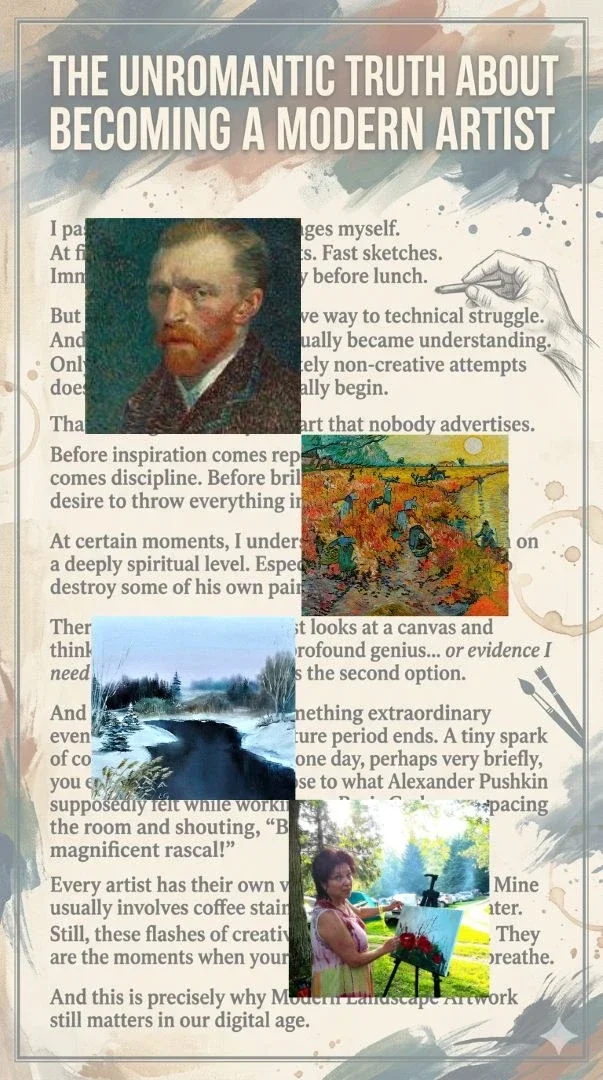
Only after dozens of completely non-creative attempts does the creative process finally begin.
There are days when an artist looks at a canvas and thinks, "This work is either profound genius… or evidence I need more sleep.”
Usually, it is the second option.
And yet, if you continue, something extraordinary eventually happens.
The torture period ends.
A tiny spark of confidence appears.
Then one day, perhaps very briefly, you experience something close to what Alexander Pushkin supposedly felt while working on Boris Godunov—pacing the room and shouting, "Bravo, Pushkin! You magnificent rascal!”
Every artist has their own version of that moment.
Mine usually involves coffee stains and paint on my sweater.
Still, these flashes of creative exhilaration are real. They are the moments when your work finally begins to breathe.
And this is precisely why Modern Landscape Artwork still matters in our digital age.
What the French Impressionists Never Warned Us About.
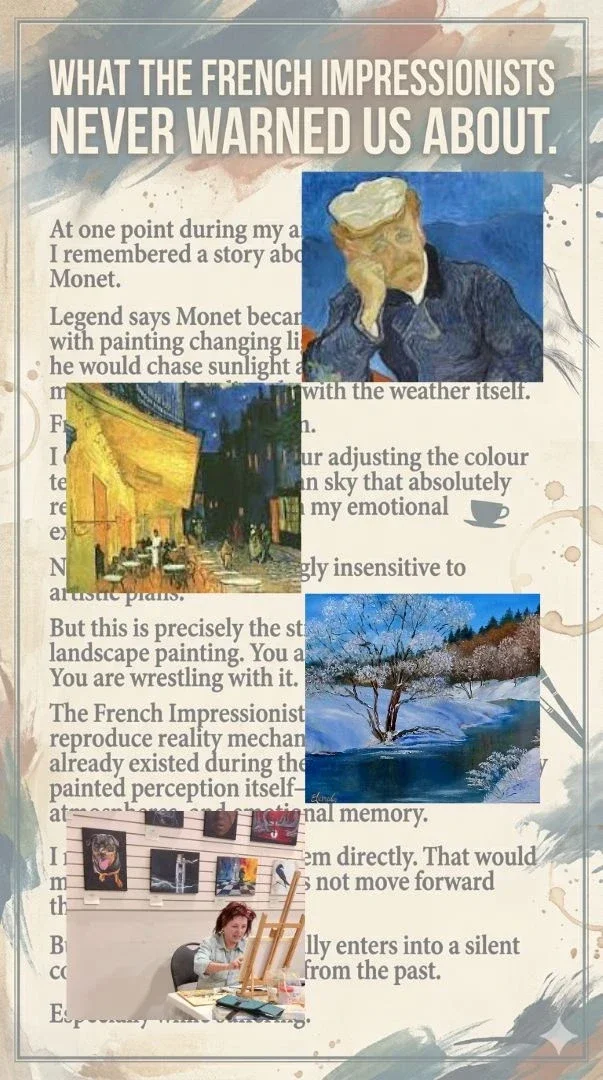
The French Impressionists were not trying to reproduce reality mechanically.
At one point during my artistic journey, I remembered a story about Claude Monet.
Legend says Monet became so obsessed with painting changing light conditions that he would chase sunlight across his garden like a man negotiating directly with the weather itself.
Frankly, I understand him.
I once spent nearly an hour adjusting the colour temperature of a Canadian sky that absolutely refused to cooperate with my emotional expectations.
Nature can be astonishingly insensitive to artistic plans.
But this is precisely the strange beauty of landscape painting. You are not copying nature. You are wrestling with it.
The French Impressionists were not trying to reproduce reality mechanically. Photography already existed during their lifetime. Instead, they painted perception itself—fleeting light, unstable atmospheres, and emotional memory.
I never tried to imitate them directly. That would make little sense. Art does not move forward through imitation.
But every painter eventually enters into a silent conversation with artists from the past.
Especially while suffering.
When a Painting Quietly Travels Across the World.
One of the strangest experiences in an artist’s life is realizing that your work begins living independently from you.
A friend of mine once purchased one of my Canadian landscapes as a farewell gift for his corporate colleague. Her work contract in Canada had ended, and she was returning home to Ireland.
He wanted her to take with her not merely a souvenir but a fragment of emotional memory.
So somewhere now, in a house in Ireland, hangs my painting of Canadian nature.
I still find that astonishing.
This is what makes Art with Emotional Impact fundamentally different from decoration.
A real painting does not simply match furniture.
It stores time.
It stores atmosphere.
It stores human experience.
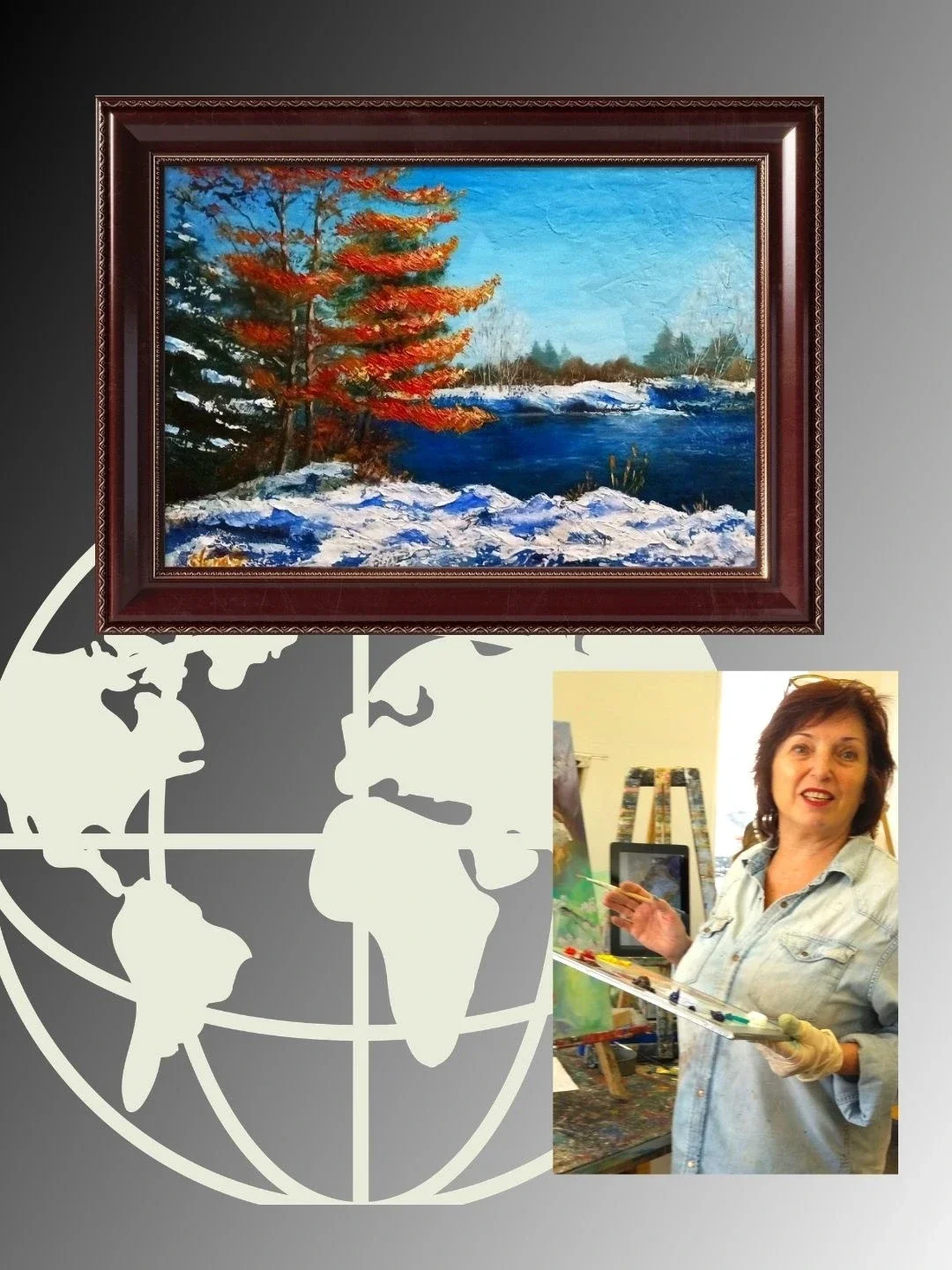
So somewhere now, in a house in Ireland, hangs my painting of Canadian nature.
That is why serious collectors increasingly seek Art that Tells a Story rather than purely decorative images.
Tuscany, Ontario, and the Geography of Memory.
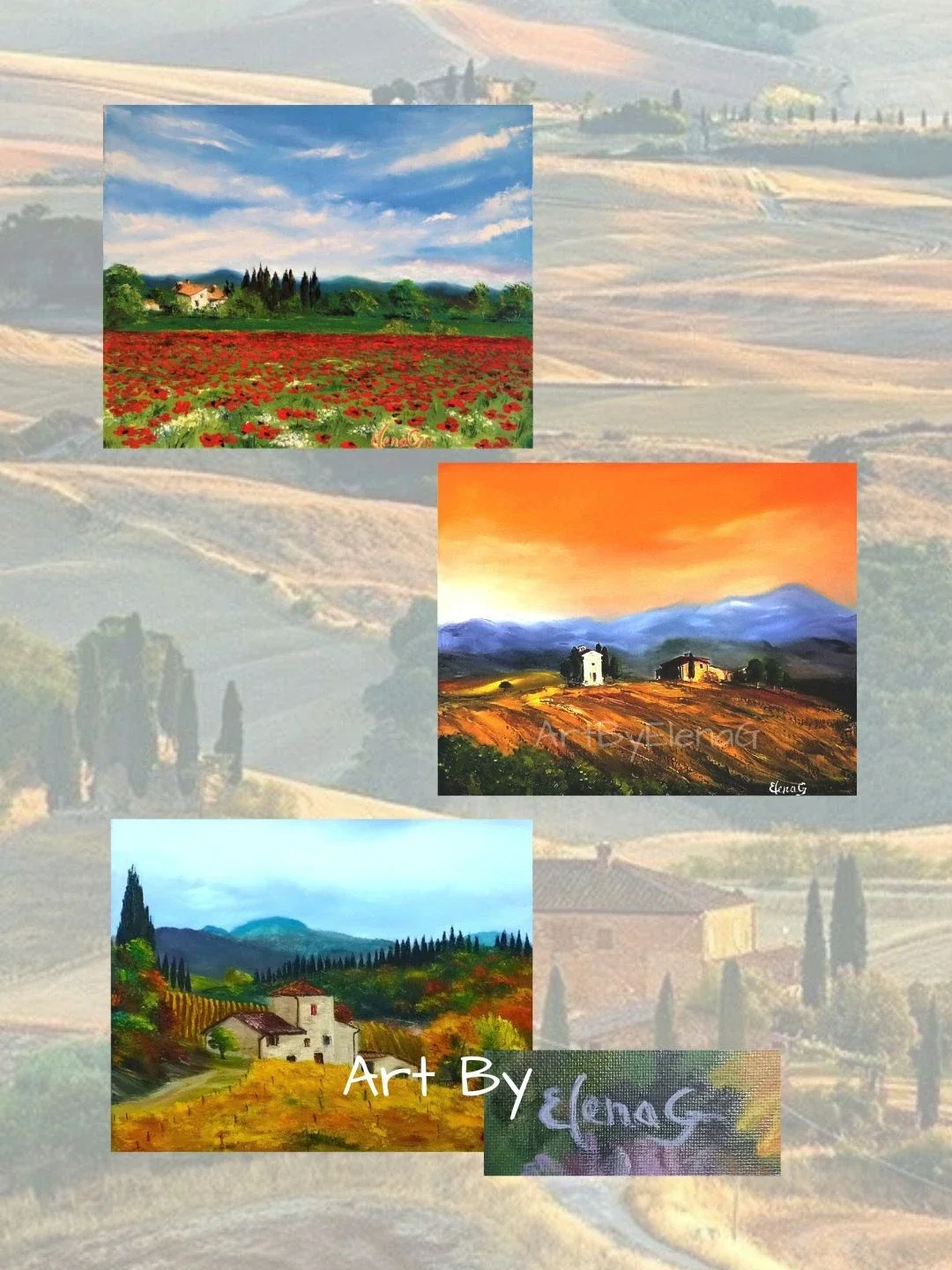
Memory edits landscapes differently than Photoshop ever could.
After returning from Italy, I could not resist creating a triptych inspired by Tuscany.
My husband had taken countless photographs during our travels, and yes, I used some of them as references. But references are not the same as vision.
The real material came from memory itself:
the depth of the fields,
the rhythm of the hills,
the impossible silence of ancient Tuscan towns.
Memory edits landscapes differently than Photoshop ever could.
The same thing happened with Golden Lake in northeastern Ontario, where a close friend developed a cottage community project.
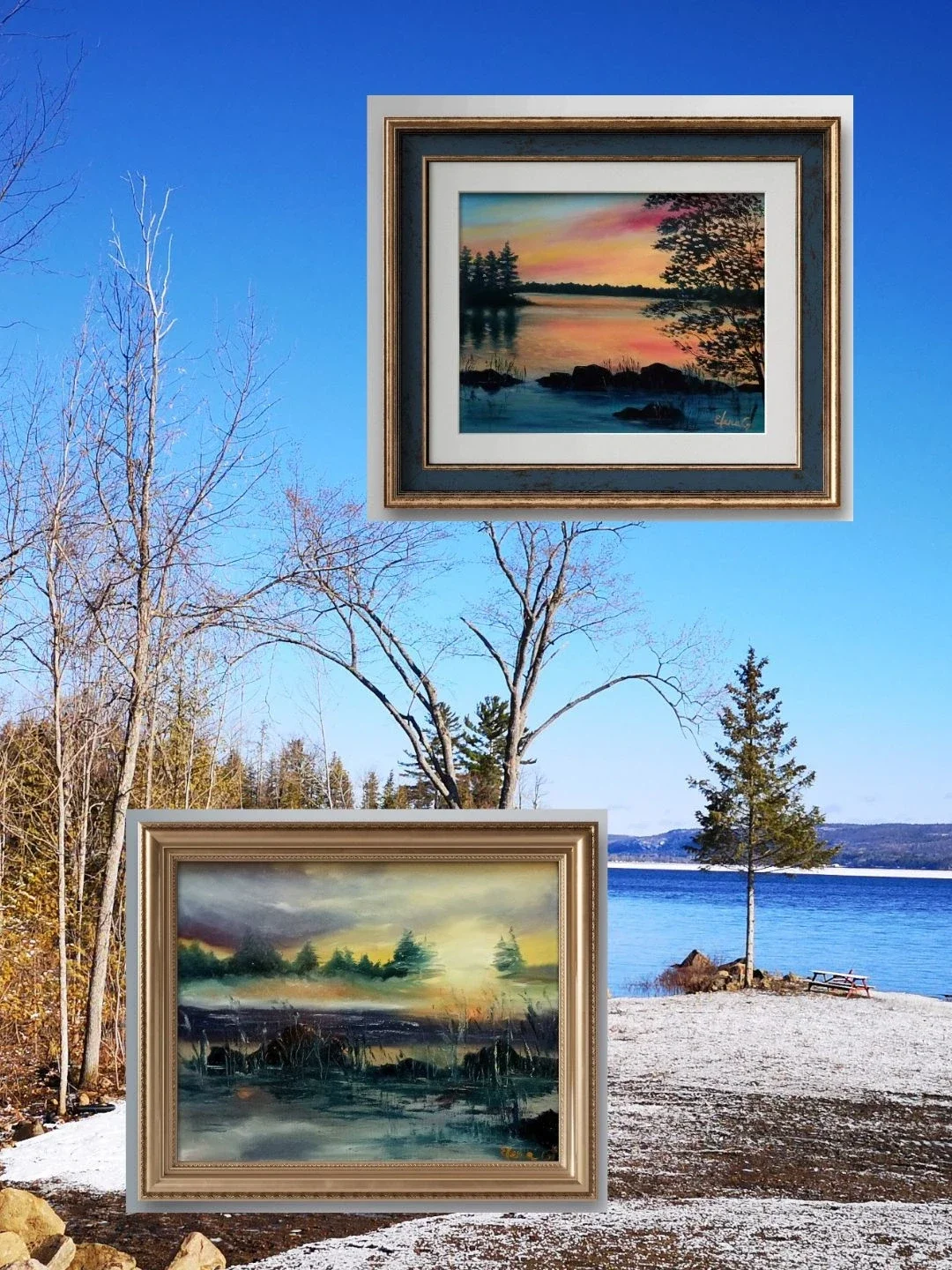
A painted landscape preserves a historical moment of a real place — not mechanically, but emotionally.
Over many visits, through changing seasons and different stages of construction, those landscapes slowly entered my visual language. Eventually, they demanded to become paintings.
And perhaps this is why landscape painting continues to hold enduring value within a thoughtfully Curated Art Collection.
A painted landscape preserves a historical moment of a real place — not mechanically, but emotionally.
I believe this idea echoes the philosophy of J. M. W. Turner, who understood that landscapes become visual archives of human civilization itself.
Learning to Paint the Sea Without Drowning Emotionally.
Then came the sea.
Every painter eventually becomes arrogant enough to think the following:
“How difficult can water really be?”
An excellent way to humble yourself.
Marine painting introduced entirely new challenges:
- movement,
- transparency,
- atmospheric moisture,
- reflected light,
- and foam that behaves like pure chaos.
- Studying the works of Ivan Aivazovsky suddenly became less academic and more existential.
How did he make water breathe?
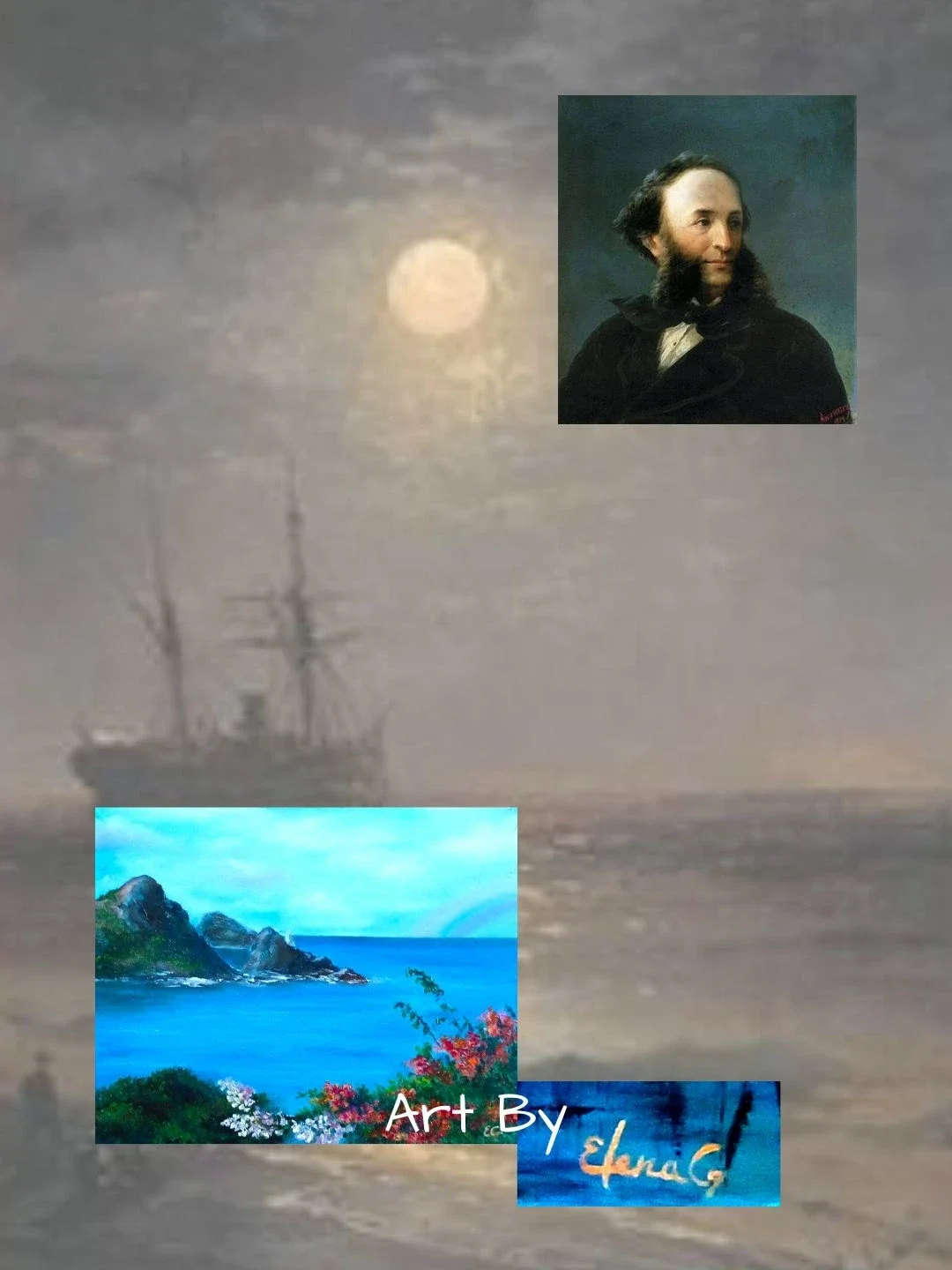
Studying the works of Ivan Aivazovsky suddenly became less academic and more existential.
How did he paint distance so convincingly that you almost smell salt in the air? These are the mysteries painters chase for decades.
And sometimes, unexpectedly, the audience answers back.
The Fifteen-Minute Silence at an Art Fair.
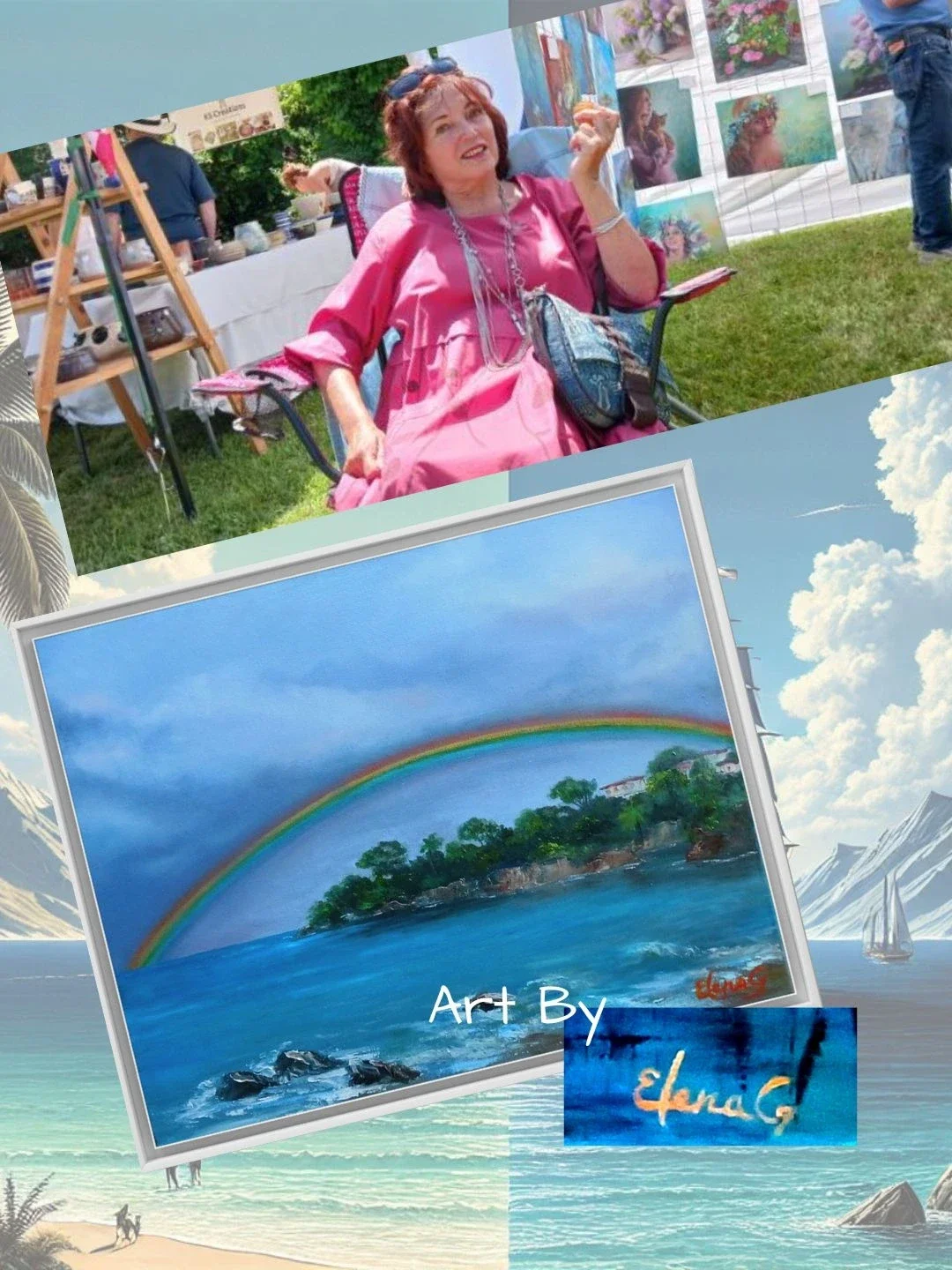
The real reason landscape art survives every technological revolution. Not because people need more images. But because people still need connection.
Once, my husband and I participated in an art fair where we exhibited a seascape inspired by the Dominican coastline after rain—complete with a rainbow breaking through storm clouds.
One visitor stopped in front of the painting.
Five minutes passed.
Then ten.
Then fifteen.
Finally, he turned to us and began telling his life story.
The painting had awakened deeply personal memories for him. Memories we could never have predicted.
That moment stunned us both.
This is because no artist can fully anticipate how another human being will emotionally enter a painting.
And perhaps this is the real reason landscape art survives every technological revolution.
Not because people need more images.
But because people still need connection.
By the way, my husband wrote about that case in his blog.
You can read it at
https://www.artbyelenag.com/blog-painting-tales/2917396_blog-29.
For Art for Serious Collectors, this emotional resonance often becomes more valuable than technical perfection itself. The strongest Collectible Art carries memory, atmosphere, and psychological presence long after trends disappear.
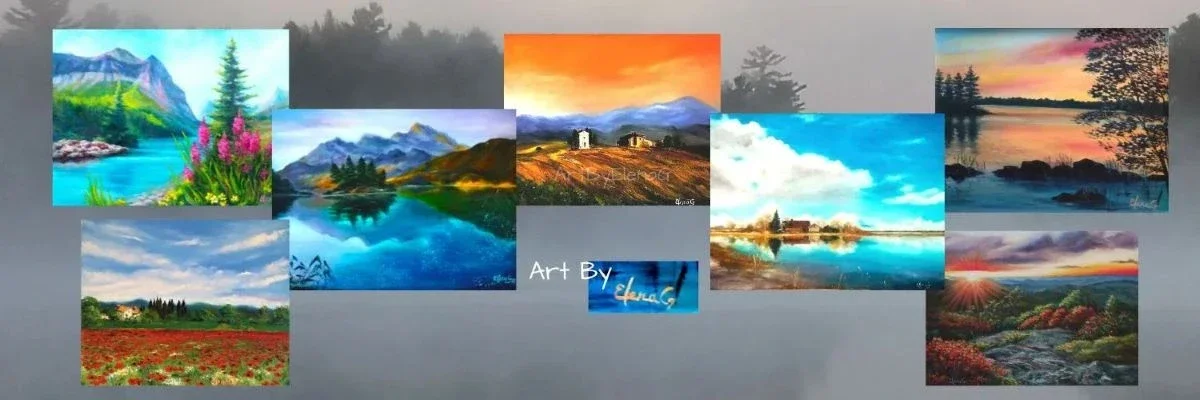
A camera records the world. A painting records human presence in the world.
Perhaps that is also why some collectors quietly search today for Investment Art Pieces and even emerging Blue-Chip Potential Artists whose works preserve not only beauty but also emotional authenticity.
A camera records the world.
A painting records human presence in the world.
And despite all our filters, algorithms, and digital perfection, that remains something astonishingly difficult to replace.
Thanks to everyone who read my monologue to the end; I will gladly share more about my liveliest genre in the next publication.
ElenaG.
P.S. All those who want to see more of my landscape paintings, welcome to
https://www.artbyelenag.com/landscape-gallery.
The creator of this blog is also the driving force behind its concept. After writing the text, the author used AI to make modifications. (ChatGPT)
Add comment
Comments